

Recently, I visited a friend who is a somebody.
He and his wife have a nice big house, fancy cars, a beautiful baby girl, status, fulfilling jobs, and a healthy marriage. They’re both wonderful people and generously hosted Toriya and me at their compound for 10 days.
While I was enjoying their company, I noticed an unwanted guest had followed me there.
No matter how much I seem to “practice detachment,” the comparison bug always seems to find a way to burrow back into my mind. It was particularly prevalent here because, in an alternate reality, I have this life of material wealth.
I met this particular friend in my old sales job, where we pushed each other for years as fierce competitors. We were neck and neck in the race towards “success” for most of our relationship.
Then he left that sales company for another, more lucrative sales opportunity, and I left that sales company to go to India. That is where our worldly competition seemed to end, for while he went on to build an organization that made him millions, I became voluntarily unemployed.
At the time, my decision felt right. Frankly, it still feels right, which is why I think I’m a tad frustrated that the comparison bug has come knocking on my door. I didn’t go to India to achieve anything; I went because I felt called.
However, my mind might say otherwise. It would argue that I went to India very much to achieve something—the end of suffering. And it’s not entirely wrong.
Most of my life has been spent in pursuit of greatness. Since early childhood, I learned the art of setting and achieving goals. When I was a young swimmer, I was taught the power of visualization and would picture my gold-medal performances before I ever hit the water.
In school, I sacrificed sleep to excel academically and athletically. To a degree, it worked. I didn’t go to the Olympics, but I was named valedictorian of a graduating class of 500+ and won St. Louis’ student-athlete of the year award.
But still, I didn’t go to the Olympics. No matter what I accomplished, it was always quickly sullied in the shadow of those who were “better.” No matter what I did, there was always something more to do. I lived in a constant flux of pride and disappointment, with hints of contempt and envy.
My life was one metaphorical mountain peak after another. And while the views from up top were always grand, my sights (and happiness) inevitably sought out the next highest peak.
When I went to India, those thought patterns that had dominated most of my life seemed to loosen their grip. Living in the jungle, where life is stripped to the bare essentials, had a transformative effect on me. I dive more into that journey through the numbered posts on my publication, The Unhurried Life. The healing waters of the community I was a part of helped to calm the embers of my desire.
Although I’d like to say I was cured completely, old habits really do die hard. Given the right breeze (and the temptation of a shiny object of desire), those unresolved embers spark back to life. Especially when the “shiny object” lets me stay in their guest house.
While I may not have improved as much as I would have liked during my sabbatical, I do think I’m becoming more aware of the problem.
Previously, when around my triggers (wealth, success, etc), I would have been overcome by craving and let that unconsciously fuel my ambition. Now I at least notice when the greenness of envy overtakes my vision. It may not be a total victory, but it’s progress. In that noticing, I have space to choose a different reality.
It’s important to note here that I don’t think any path is inherently right or wrong. Thus, if pursuing wealth and status seems like the right path for someone, wonderful. This reflection is not about demonizing the pursuit of material riches. Who knows, I may find myself on that course again one day.
One thing I’ve been learning on my journey is to disregard any judgments my brain has about others’ journeys. One of the most beautiful aspects of life on Earth is its diversity. Diversity of backgrounds, religions, race, diet, and even thought.
That also includes diversity in life paths. I’m a believer that all roads lead to the same end; they just might offer different scenery along the way.
The real challenge for me doesn’t seem to be restraint from judging others’ paths, but from judging my own.
As one of my old mentors used to say, “You can’t determine the moral of a story before the story is finished.” Yet my mind is always seeking either validation that I “did the right thing” in dropping out of the Rat Race and moving to India, or it’s seeking to berate me for losing my “position” in the race. Either way, the mind is never happy.
But maybe that’s the entire problem; I’m still identifying with my mind.
While in India, my teacher there talked often about how “we must become completely ok with being a nobody.” He referenced the Matrix movie and how Neo was the One only because he didn’t think he was, nor did he really want to be. He was special by virtue of being completely unabsorbed by the idea of being special. There’s a similar parallel with Frodo in The Lord of the Rings.
I, on the other hand, cried when I heard the Les Brown motivational talk “I’m the One,” because, despite what the other listeners may think, he was clearly talking about me.
That may be why, as I began working on the idea of being a nobody, it became a rather appealing new identity to my ego.
Instead of being a somebody, I could be the person with the potential to be a somebody, but who overcame the urge and broke free from the Rat Race to become content with being a nobody, thereby making me superior to all those somebodies out there who succumbed to said urge. Phew, take a breather. Pretty spiritual, am I right?
My mind will either think I’m special because I’m somebody, or it will think I’m special because I’m detached and enlightened enough to be a nobody. So basically, I’m f***** regardless.
But that’s just the nature of the mind, isn’t it? F***** regardless? I’m constantly reminded by these reflections that there may be no fixing these thoughts; my only hope is to not give them so much weight.
That can be difficult, however, when you live in an environment that is constantly promoting the idea of standing out and being special.
The advertising industry has spent trillions of dollars on ensuring that, from a young age, I’ve believed I can only truly be myself when I stand out; when I mean something; when I’m important.
If you’re sad, angry, confused, or downright depressed, “more” is always the answer.
I recently cried my way through the Avicii documentary. When he became one of the most famous DJs in the world, he saw an American news report, “Avicii makes millions and retires at 26.” He laughed and said, “That’s such an American way to think about it.” He wasn’t retiring from making music; he was trying to distance himself from the business of music.
He later went on to say, “I was a lot happier before I was famous than after I was famous.” Greed has a way of creeping into any positive experience and turning it sour with its necrotic touch.
I cannot say I personally understand his experience, as I am (thankfully) not world-famous. But I did get a taste of ‘fame within a bubble’ while being a record-breaker and top producer at my old company. It changes the way people treat you. Interactions seem to become less about people wanting to make deep connections and more about how associating with you can improve their own status.
I know this experientially, so why does a part of me still want it? It’s both baffling and eternally frustrating. I guess I’m just not healed of that ancient disease called “not enough.” And the only prescription humanity seems to promote as a cure is “more.”
Though we all secretly know it never works.
So, I will continue experimenting and feeling my way towards the one prescription I do believe works; the light of Presence—of the One, of the Universe, of God—whose fundamental law is “there is always enough.” In the meantime, these reflections help.
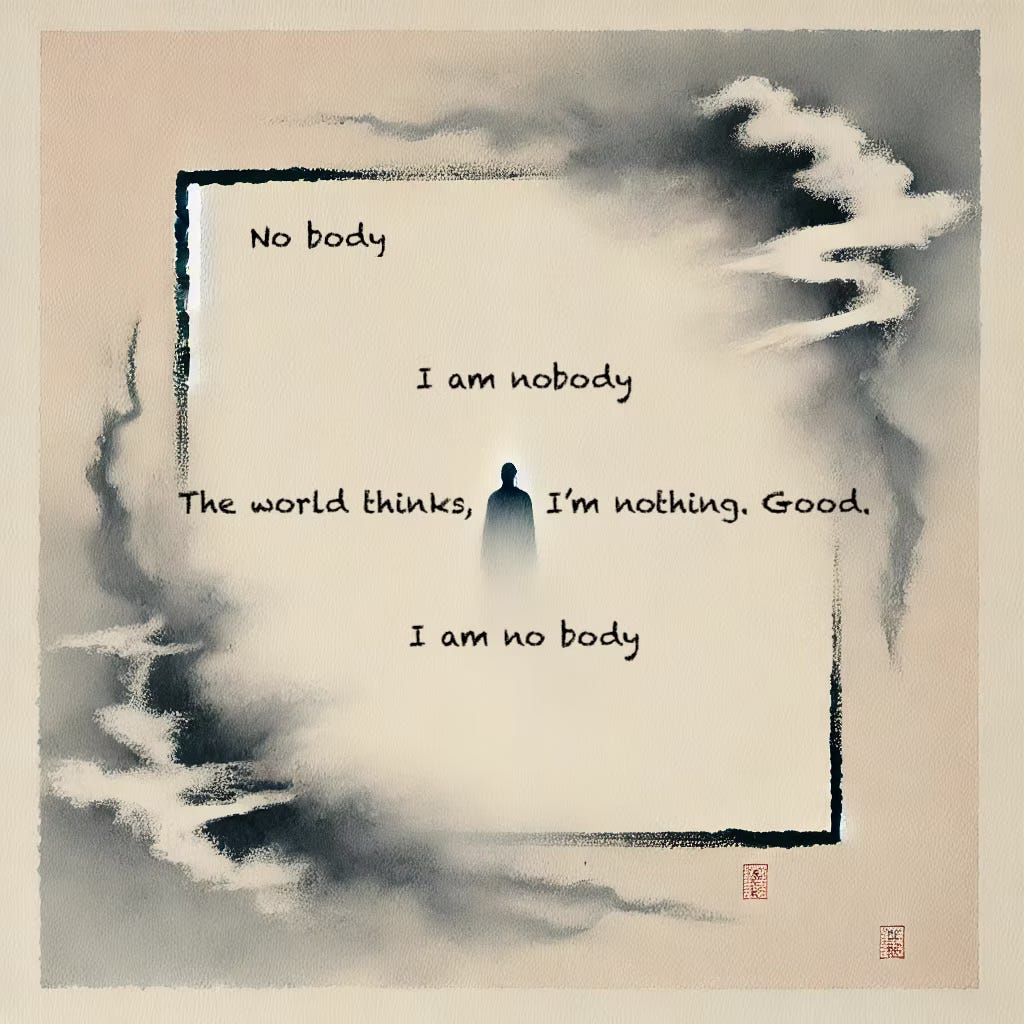
I wrote this poem over a year ago. Ironically (or coincidentally), it’s a haiku. I call it ironic because I think one way my old patterns of “more” tend to show up is in my writing, specifically, through wordiness.
I always seem to have a lot to say. Haikus are, therefore, inherently a pretty difficult artform for me. After all, I need a large word count to say anything of substance. Right?
Thus, I couldn’t think of a better way to end this post.
No body

I am nobody
The world thinks, I’m nothing. Good.
I am no body
As always, filled with heart. Great work, Shane!
this is wise, humble and wonderful, thanks for sharing it!