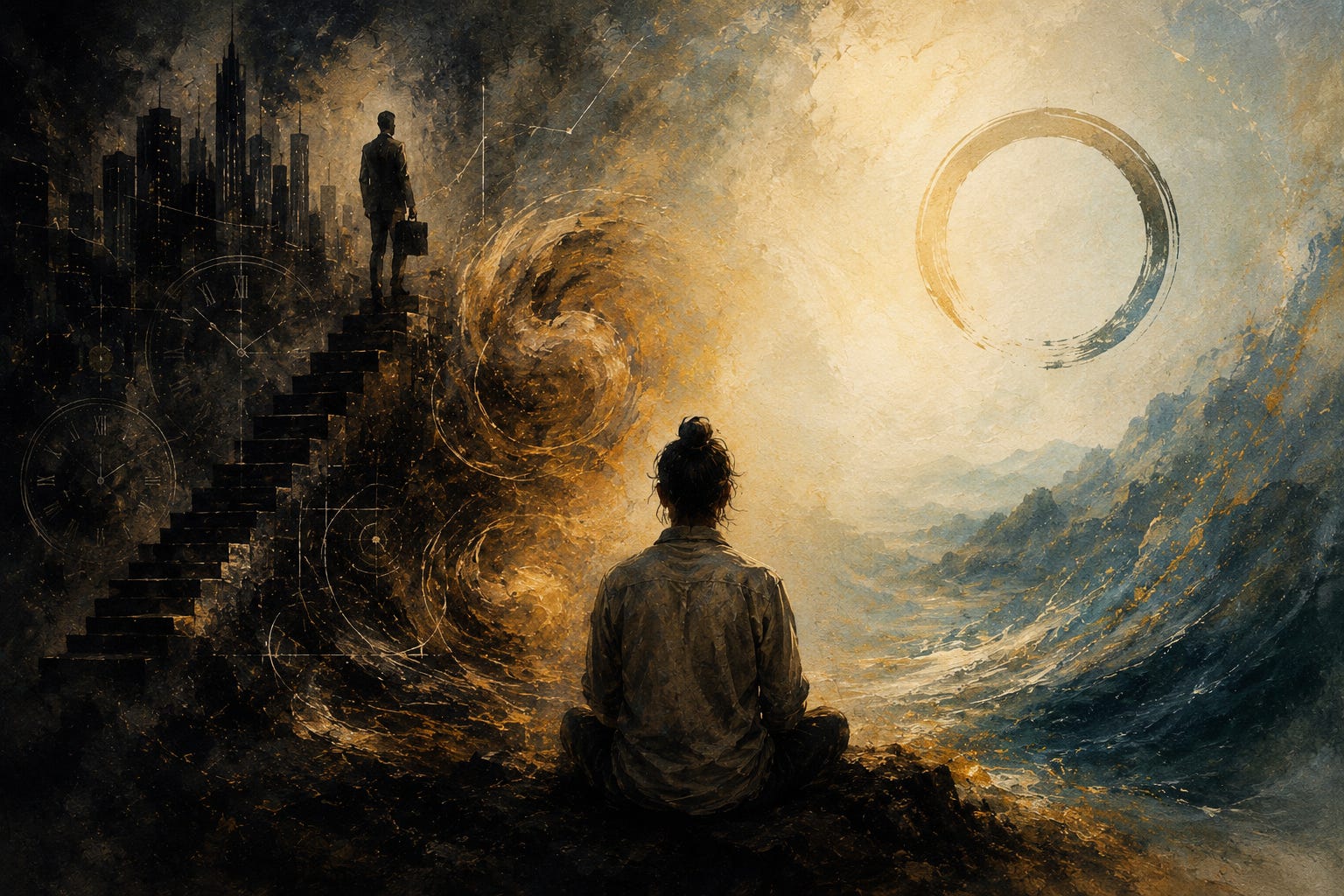
There are at least three kinds of disease.
We all know about the diseases of the body, and we tend to put a lot of effort into fixing them. More recently, we’ve begun discussing diseases of the mind, and it’s becoming more common for people to put effort into healing them as well.
The lesser-talked-about disease is the disease of the spirit.
That’s the one we tend to put the least effort into healing. Ironically, I believe it’s also the foundation of our healing.
Many people would argue, and there’s evidence to show, that the diseases of the body are often linked to diseases of the mind. Stress, for example, has been clinically proven to cause numerous chronic diseases.
But where do diseases of the mind come from?
Of course, it’s important to acknowledge the possibility of hormonal and chemical imbalances in people. There are many psychological or physiological ways to approach this topic, and I wouldn’t say any is better or worse than the approach I’m reflecting on today.
This philosophical approach is just one shade of a multicolored picture. I think the reason I gravitate towards the philosophic approach is that it leaves space in the color palette for the other shades as well.
What is a disease?
There are various ways to define it, but I tend to think of it simply: existing outside of equilibrium.
You can even split the word up: dis, meaning ‘separate from’. And what are we separated from? Ease, of course.
Maybe it’s because I studied biology in college, so my mind gravitates toward the natural state of balance we find in nature, a scale that always seems to correct toward the center. Or maybe it’s because I read the Tao daily and resonate with the simple, yet powerful approach that Wu Wei encourages.
However you define it, I think we can all agree on one thing: disease is unpleasant, and therefore it’s a state most people try to avoid.
Which, to be fair, is quite reasonable. It’s why so many people dedicate their efforts to living a life of harmony and ease.
But here’s the irony: any struggle is unpleasant. So the struggle to be pleasant is… unpleasant. The fight for peace becomes another form of war. The chase for ease becomes another form of tension.
Which brings me to the point I’m learning to dance with: there are certain “solutions” that look like cures, but subtly deepen the sickness. They promise relief while keeping us hooked on the same inner mechanism that brought about the suffering.
Our inner mechanisms can vary person to person, as we all struggle with different things in this life. However, there are some universal struggles that will sink their claws into us all if we’re not careful.
One of the most dangerous socially promoted traps, for me, is the disease of ambition.
Ambition isn’t all bad, of course, so it might sound extreme to call it a disease. But looking to ambition to solve my state of dis-ease is a fool’s errand… because oftentimes it’s my relentless ambition that put me in that state to begin with.
If you’ve been reading my blog, you know I recently returned to the US after a nearly three-year sabbatical, a good chunk of which was spent in India—partly in an attempt to heal my “Western mind.”
Now that I’m back, it’s become an ongoing practice: watching old habits return, and seeing if I can stay conscious enough to let them pass without falling under their spell.
I’ve realized that the moment I stepped back into “normal” life, the mind immediately started yearning for outcomes: about momentum, about making up for lost time, about “getting serious.”
In essence, I’m entering back into the game, while desperately hoping that as I play, I will keep remembering it’s a game.
Of course, the hardest part is that most of the people I interact with day to day don’t treat it like a game.
I’m not blaming them. I’m responsible for my own reality. But there is something inherently difficult about maintaining lightheartedness when society at large does everything it can to stress the absolute importance of our material existence. As if our value is proven by our output, status, pace, and ranking.
And the most dangerous part is, ambition doesn’t always sound outwardly selfish.
It’s not always a roaring hunger for power. Instead, it often sounds noble: discipline, excellence, self-improvement, “providing,” making a difference. It promises that if you do enough, become enough, achieve enough… then you can finally relax.
But “then” is a moving target.
Like Forrest Gump, I just want to run. I don’t need the rest of the world to time me or tell me how I rank compared to everyone else.
Because sooner or later, that replaces the joy of running with the striving to win. It replaces the process with the output. And one can only be so happy when all their satisfaction lies in fleeting moments of worldly victory.
Before leaving for India, this insanity was becoming increasingly apparent to me. In fact, it left a disdainful taste in my mouth that had me walking around as a judgmental cynic. Even then, I didn’t like the way that felt. I could tell I was using judgment like a shield: if I condemned the game loudly enough, maybe it couldn’t seduce me anymore.
But that wasn’t wisdom, it was just another form of agitation.
So I was grateful that, throughout my sabbatical, my cynicism softened and eventually gave way to a sense of compassion. Though sometimes, if I’m still feeling judgmental, the compassion comes across more as sorrow for the state of the world (and particularly for the people in it).
But for the most part, I recognize that everybody is on their own journey, and that’s a wonderful thing. It’s simply the human condition: craving, striving, comparing, fearing, and calling it normal.
Yet, however “human”… the addiction burns.
Because ambition works, at least in the short term. It can build impressive things. It can create comfort and stability. It can even help people.
The problem is what happens inside the person who’s using it as a substitute for peace. The mind gets trained to chase, and our attention gets rented out to tomorrow. The soul starts living as if life is a résumé, something to be evaluated, rather than an experience meant to be inhabited.
That’s why ambition can feel like an addiction to me. Not because building is wrong, but because the mind turns building into a way to avoid being here. Now.
I think about this often. That’s probably why this poem came to me during our travels.
(In) Sanity

People thought I was crazy, they called me insane
When I said “no thank you” to their corporate game
I thought it’d be fun to climb up the ladder
But why should a game leave you scarred, bruised, and battered?

I’m not one to say that commerce is bad
For we need food, clothing, and a roof over our head
The problem isn’t business, it’s man’s folly of greed
We take more of the pie than we actually need

Business is about future, it’s rarely in the now
Plan for success and work by the sweat of others’ brow
Abandon all else, we must secure our nest egg
Sacrifice in pursuit of glory, so be it if you break some legs

Is this really the point? If it is, then I’ll stand alone
God is dead, and Capitalism has taken the throne
The boss says we serve others, but that’s a load of crap
When goodwill becomes coverup for pursuing a treasure map

I thought I could dabble, that I would keep my head
But the drug’s too addictive, and it took me to bed
So I had to step out, maybe some day I’ll return
But that thought truly scares me, for the addiction still burns

There must be a way that we can do this thing right
Business can be a joy, where gain is measured by delight
The world will not end if we stop buying things
It’ll give marketers more time for the joy family brings

It’s not crazy to question norms, it’s insane to be a sheep
Stuck in a loop of consumption, where real dreams fall asleep
Needing wealth to be happy is to fail life’s biggest test
A prison made of gold is still a prison nonetheless

To really serve the world, we must end all our greed
This Earth is abundant if we only take what we need
So let them call you crazy, it’s fun to be insane!
What could be more psychotic than trading your life for a game?

When a society praises those who take more
All balance has gone, and our spirit becomes poor
Virtue and integrity have been reduced to a concept
Is it crazy to be content? Yes, when materialism’s a precept

You see, the Rat Race is a game that no one wins. When the whole world around you feels insane, I hope you are able to remain (in)sane
I don’t want to pretend I’ve “outgrown” ambition. I haven’t. I just want a healthier relationship with it.
So, since I spent most of this reflection talking about the negative sides of ambition, what about some of the positives?
When ambition is balanced—when it’s grounded in self-worth and rooted in the unmistakable, unshakable goodness of life—it can lend itself to a wonderful game. It can be creative play. It can be devotion. It can be service that doesn’t need applause to feel meaningful.
But that’s just it.
It only works if I can keep remembering what it is: a game. A temporary one. A beautiful one, sometimes. A brutal one, other times. But regardless… not the measure of my worth.
Because the moment my peace depends on the scoreboard, the addiction has won.
So I’m writing this as much to remind myself as anyone else: I don’t want to be ambition-driven. I want to be LIFE-driven. I want ambition to be something I use when it’s helpful—not something that uses me.
And if I can hold that line, gentle but firm, then maybe I can return to the world without losing myself in it.
Love,
Shane